Monday, May 30, 2011

On the importance of variety


I'm sure you've all heard of and read - to nauseating levels in pop culture, sometimes - the saying that "variety is the spice of life." I'm sure at least some of you have read nerdlikejazzy's recent viral blogpost '18 Things I Wish Someone Would’ve Told Me at 18,' point number 4 of which elaborates on "exploring new ideas and opportunities often." In this post, which in all likelihood will be my last one for the next 6 months owing to my busy schedule, I'll add a few points to support the imperative of varied experiences in life. Don't worry, I'm not gonna get into any heavy-handed, pseudophilosophical discussions about the meaning of life or the "painful journey" we call life. I'll try and work it out from a scientific perspective only and skim the surface of the scientific basis that substantiates the claim.

The American psychologist Fred Attneave writes about the human brain:
"If there were just one brain cell to cope with each image that we can distinguish in all its presentations, the volume of the brain would have to be measured in cubic light years."

Meaning that there is just a tiny bit of information (information as in an image) that can be stored in and processed by one brain cell, and since we come across literally infinite images (well not literally!) each waking moment of our lives, each human brain would have to be the size of a galaxy to be able to successfully process all the images (or other information) we see at any given time, all the time. But we know this isn't true, since we know how big our brains really are - anywhere from the size of a coconut, for most of us, to the size of a peanut, for some people like Arindam Chaudhuri and his disciples. Despite the size that is really required of the brain to process information, our brain does it with extraordinary precision using a size that is only a billionth of what is required. How so, though?

The brain has a workaround trick to solve this, discovered independently in the 1950s by Barlow and Attneave. It has evolved a very sophisticated and complex system of erasing redundancy. Redundancy is the opposite of information; redundancy is a measure of unsurprisingness, information a measure of surprisingness. To illustrate this with an analogy, imagine what a worthless waste of paper it would be if the newspapers reported every single day that the sun rose in the east that day. It's redundant information, and everyone knows without being reminded that the sun rises in the east everyday. However, in the unlikely event that the sun rises in the west on a fateful day, that would be something of a news to report. That is a change from the daily routine of sun's rising in the east, and newspapers will not fail to report it the following day. The information content of it would be high, measured as the 'surprise value' of the message. The brain works in a very similar way, regardless of the body sense to which it is responding or the memory it is storing, as there is only a limited number of neurons for the brain to work with. In fact, the entire nervous system works this way. I'll explore two examples, of senses in particular.

The eye. Suppose you are looking at a black rectangle on a white background. The whole scene is projected on to your retina - you can think of the retina as a screen covered with a dense carpet of tiny photocells, the rods and cones. In theory, each photocell could report to the brain the exact state of the light falling upon it. But the scene we are looking at is massively redundant. Cells registering black are overwhelmingly likely to be surrounded by other cells registering black. Cells registering white are nearly all surrounded by other white-signalling cells. The important exceptions are cells on edges. Those on the white side of an edge signal white themselves and so do their neighbours that sit further into the white area. But their neighbours on the other side are in the black area. Using a phenomenon called 'lateral inhibition,' the brain can reconstruct the whole scene with just the retinal cells on edges firing. There is a massive savings in nerve impulses. The eye tells the brain only about edges and the brain fills in the boring bits between. Once again, redundancy is removed and only information gets through. Any image you see, including these words as you read as well as of anything else that is laying by your computer, is reconstructed in your brain through this same process of inhibition of redundancy.

You can see this lateral inhibition in action in this optical illusion below. Cover the central divide between the two shades of grey with your index finger and stare at your finger for a few seconds. Now both sides appear to be made of the same shade of grey, or very nearly the same. Now move your finger off the screen, and the difference between the shade drastically increases. Can you reason why?


The ear. Hearing, all audible sounds as analogous to images, works very similar to the eye as described above: by cutting down on the redundancy in the pitch of the sound, filtering in only the information about the variation in pitch, and then the brain processing and reconstructing the sound - all in real time. But with sound, there is an additional factor: of time itself. To explain just how dramatically the brain filters out redundancy, let me cite this study conducted by researchers at Rice University. Two groups of subjects were made to listen to two sound pieces respectively. The first sound, given to the first group, was of constant pitch whereas the second sound, given to the second group, was of varying pitch. The groups were not told of the duration of the sound they were listening to, and none of them had clocks or watches or any other way of measuring time. After both groups finished listening to the sounds, when asked to guess the duration of the sound piece they just listened to, all the subjects of the first group (the constant-pitch group) reported a duration that was much less than the duration reported by the subjects of the second group - despite the fact that both sound pieces were of the exact same duration! The first group subjects' brains not only cut down on the redundancy of constant pitch but also reduced the subjective perception of time that was associated with the redundant information. The second group subjects' brains, however, because of the variation in pitch and thus more 'surprise content,' were able to store not only more information about the sound but also more of the overall time associated with it.

Where I am going with all these illustrations and citations should be clear at this point. The reason why four years of college feel like four months is because of the same reason that the brain remembers a constant-pitch sound to be shorter than it is: repetitive, routine tasks are compacted by the brain into just a few, typical, representative prototypes and stored into memory locations where the subjective perception of time is also cut short in accordance with those compressed memories, thereby filtering out not only the redundancies of the experience but also much of the perception of time that the experience is made of. This essentially is the same way our brain retains boiled-down memories over an entire lifetime.

So, to counter this seeming 'drawback' in the design of our brain, to keep life from feeling short-lived and having passed in a flash, to avoid the perception of time having flown like an arrow, it's most advisable to have different kinds of varied experiences that the brain can perceive as information or 'surprise content', to try new things if only for the sake of the feel, to break the patterns of tedious, recurrent routine that come off as redundant, and also to collect as many photos, videos and souvenirs of the experience - because remember this: there's only so much the brain can remember.

_

Tuesday, May 3, 2011

Glimpses of genius

The next suitable person you’re in light conversation with, you stop suddenly in the middle of the conversation and look at the person closely and say, “What’s wrong?” You say it in a concerned way. He’ll say, “What do you mean?” You say, “Something’s wrong. I can tell. What is it?” And he’ll look stunned and say, “How did you know?” He doesn’t realize something’s always wrong, with everybody. Often more than one thing. He doesn’t know everybody’s always going around all the time with something wrong and believing they’re exerting great willpower and control to keep other people, for whom they think nothing’s ever wrong, from seeing it. This is the way of people. Suddenly ask what’s wrong and whether they open up and spill their guts or deny it and pretend you’re off, they’ll think you’re perceptive and understanding. They’ll either be grateful, or they’ll be frightened and avoid you from then on. Both reactions have their uses, as we’ll get to. You can play it either way. This works over 90 percent of the time.

-The Pale King, pages 17-18, David Foster Wallace

Trivia: While googling a sentence from this paragraph to find the rest of it and thus save the effort and time in typing it out for this blog post, I discovered that dozens of other bloggers have blogged this exact same quote! (Example 1, Example 2, Example 3 , and many more...)

Monday, May 2, 2011

Source Code: A Review, or a Review of a Review

Under peer pressure or with sly secondary intentions, I’m being made to write this review by the two other, equally worthless assholes (Rohan & Himanshu) I watched this film with yesterday at the movies. I civilly oblige.

So, yeah. First things first. Unlike them both, who thought this film didn’t live up to the hype (what with all the raving reviews and a 90% rating at Rotten Tomatoes that gave Inception an appropriate 75%), I thought it way surpassed the hype. Actually, leaving popular hype where it belongs (in the shitbucket), Source Code surpassed my own expectations of Duncan Jones whose directorial debut, Moon, being awesome and everything, had me looking forward to his next project for about a year now. And having now seen this piece of celluloid masterpiece, I’m looking more forward to his next project, Mute, than I did for this.

OK, my personal raving aside, time for that which is implicitly promised when I review: Less discussing and more diss-cuss-ing. Source Code is as bad a title for a film as it is for the sci-fi invention used in the film. Source code, as all you proper, would-be and engineer of sorts know, is a generic term for the text part of a computer program. To name your biggest, game-changing technological creation as Source Code makes me question your judgment as well your credentials as a PhD who can tap into the residual consciousness of the dead. Additionally, naming your film by a dry, common software engineering terminology can have anyone – engineers and non-engineers alike – assume or even judge before actually watching it as most do that it’s a computerish or softwarish or geekish film – none it could be any further from. Use some creativity, of which you are evidently brimful, while naming your films for future reference, Jones.

And now the Holy Grail of film critiquing: Masand ki pasand. To put it in simple terms, Masand’s one review of Source Code has more insights and penetrating observations, and a rating that is objectively accurate to the fifth decimal, than the planetary congregation of insights of all those who saw the film, made the film and wrote the screenplay. His unnatural eloquence and insightfulness are on display in what he aptly calls Masand’s Verdict (seriously, why call it anything else when it is exactly that – a verdict, not a review), as can be seen in this exemplary concluding statement of his Source Code verdict: "It’s not perfect." Oh man, what a bummer! It’s not perfect!

Masand’s ideal definition of a perfect film is Avatar, which he gave a singular 5/5 despite acknowledging, using his remarkable I’ve-seen-more-films-than-you-duh power of dissection, that the plot was so predictable as to numb your mind like anesthesia.

In his infinite wisdom, Masand also suggests that Inception lovers and dopers should go watch Source Code. At the risk of being exiled into oblivion for disagreeing with His Insightfulness’ suggestion, I recommend you suspend any expectations of seeing an Inception or some other pop film in this and watch it with a blank-slate preconception plate. When the movie ends and the titles roll and you realize it’s not another Inception or Déjà Vu, you are more likely than not to feel let down. Every film has its inspirations and aspirations from past films – regardless of how original it superficially appears – but to cite those films as a ruler to weigh this film against and to give false ideas of what to expect would lead to despair when the film fails to meet your expectations or goes in a different direction altogether. So put simply, let the film thrill you in its own right.

But yes, both Chris Nolan and Duncan Jones – besides hailing from England, bah! – have similar philosophy at filmmaking, though to varying degrees. Like Nolan, Jones doesn't patronize the audience by either spoon-feeding the story or preaching moral lessons at them. While much is presented visually comprehensibly, he does leave at least some aspect of the story to our imagination and lets us work out why this or that happened by following the clues here and there. He did that in Moon and he does it in SC as well in the much-discussed ending, and he does it so efficiently that the audience feel immensely rewarded when they figure out the why post gestating the questions. However, more important than these intellectual puzzles, and this is the hallmark of a good director, he packs and transforms the whole story into an engaging emotional medium that connects the screen to the audience and lets the drama, the action, the compassion for the characters and the progression of mood flow. He does this consistently for the stretch of the film, and at no point did I feel “left out” or disconnected; I was involved in it; I had lost myself in it. This sadly doesn’t happen with most films I watch.

That, however, is not to say it was all sentimental goo. Far, far from it – subtlety is the key. If there is any director who can pull off a happy ending without making it repulsively cloying (refer: Rajkumar Hirani’s brilliant, amazing, soul-bonding, generation-defining body of work that is saturated with didactic moral chapters on the "right way to do things"), it is Duncan Jones. He has decidedly become an object of envy for me, and I hope to God it stays that way!

8.5/10. Yeah!

Note:
1. Anish Kapoor’s famous sculpture Cloud Gate is featured towards the end of the film – partly chosen for its reflective features, mirror reflection being an important plot device in this film, and partly for artistic purposes.
2. Michelle Monaghan is very cute, damn it!
3. If you do not grasp the answer to the lingering question that’s on everyone’s mind at the end of the film, read this explanation below (not mine). But read only after you watch it – contains spoilers, even the very reading of the question.


SPOILER ALERT:

Q. How does Colter survive longer than 8 minutes in the final transfer to the train bomb scene in the end?

A. Colter's consciousness is sent from his body attached to the source machine in the starting universe to Sean's body in the newly created parallel universe each time source code is "started". When Sean's body is killed in the parallel universe, Colter's consciousness is returned to his body in the starting universe (because of the link via source code). Even if Sean's body isn't killed, Colter's consciousness is still returned to his body in the starting universe, and Sean regains/resumes possession of his own body in the parallel universe. Once Colter's consciousness returns to the starting universe, the source code team then interrogate his conciousness (via the computer terminal) to find out what Colter has learned and then send him to another parallel universe, rinse and repeat, rinse and repeat until they get the information they need.

When Colter is sent to a new parallel universe for the final time by Goodwin, he is able to defuse the bomb and arrest the bomber within 8 minutes and gets prepared for the last kiss of his life just at the end of 8 minutes. When Goodwin in the original universe switches off Colter's life support at the end of 8 minutes, she has terminated Colter's body, but his consciousness is in the final parallel universe. By switching off Colter's life support she has severed Colter's link to his body and he is forever trapped in Sean's body in the final parallel universe (which is what he suspected and wanted to happen). When Colter/Sean dies (presumably of old age) in the final parallel universe, only then will Colter's consciousness finally die.

Monday, March 28, 2011

My Latest Pet Peeve


Another in a long line of my pet peeves, the phrase “open to/beyond criticism” has really started to tick me off. I’d first come across the term “beyond criticism” in the context of Oprah endorsing a book into her elite class of Oprah Book Club (does she have anything in her life whose title doesn't contain her name in it, that self-indulgent, narcissistic bitch?), and I didn’t give it much thought back then for reasons I can neither recall nor, if could recall, justify. But with the increasing frequency of this term in print – used often by critics and reviewers of literary, cultural, religious and political phenomena – my peeve detector has finally rung the alarm.

Since I came across this phrase exclusively in literary context, I’ll stick to what I know. Calling a book or some other work of literature as beyond criticism categorically submits that any opinion or point of view that opposes the established awesomeness of the work can be either discredited because the (insecure) majority who pushed it past the unsafe zone of criticism disagree with it, or restricted from being uttered altogether. Now, “open to criticism” can superficially come off as a critically superior term that, as it manifestly suggests, opens the book to criticism and allows novelty and variety of opinions to be expressed unlike the other phrase; but really, it is just an elastic extension of ‘beyond criticism’ that when let free returns back to the intolerant connotations of its base phrase, ‘beyond/above criticism.’ Being ‘open to criticism’ insinuates that it can also, at some time in the future and with sufficient consensus attained, reach the point of being ‘closed to criticism’ – just a fancy way of saying it is now beyond criticism. Well, fuck that! A phrase which fundamentally grants any work of art that privilege is illiberal and despicable in equal measure. At what point, may I ask, does a work go from being ‘open to criticism’ to ‘beyond criticism’? In my book, never. As long as I am alive, no book ever written is above or beyond or closed to criticism!

This pet peeve, however, as I mentioned earlier, is highly context-specific. I have no qualms with this phrase being used in a few other areas of human affairs, such as science. That earth goes around the sun and not the other way around is above and beyond criticism, and that evolution is true hasn’t been open to criticism for well over a century and a half now.

I want to go on about how blinkered we Indians are about other people’s outlook towards something that is different from our own and how closed we make our objects of praise to criticism. But that could, true to our Indian form, make this into a pissing contest and flame war, so I’ll conclude the pet peeve with my original intention of just expressing the peeve, and nothing more.

Monday, March 7, 2011

Response to a response to my Bicycle Thieves review

So hello again, Alexander. At the outset, sorry for the delay. I'd been going through a rough patch for the past two months (you know, breakup and everything), but I'm done with the grieving stage and am back to form now. Except for a broken right hand middle finger that I broke today morning by stubbing it onto the door, but it shouldn't cause much discomfort in typing this out. I'll try and maintain brevity in this reply.

(For the uninitiated, the quoted parts are Alexander's reply to my previous post.)

Hi there, buddy! Remember me? I actually still check on your rants from time to time. I find it interesting that you write that many considered classics supposed contain: "symptoms of pretentiousness". So, am I right to assume that you dislike much of what is considered 'classic' pre-Kubrick era, because you find many of those films to contain "symptoms of pretentiousness" which takes away story? Or, do you simply mean, that it's just hard to find representative elements in just one film from one particular era, because of mentioned symptoms, which in terms makes it harder to get into, and therefore just not worth the effort?

I think I'm more inclined towards the latter. Cinema evolved over 100 years. Today's directors have a much larger database of "Do's and Don't's" that has in essence accumulated over those 100 years from hundreds of thousands of films, and that gives them an edge over the first half century's directors as to what works and what doesn't. Kubrick had a very significant influence on the following generation of filmmakers, and in my opinion, more so than any other director of the second half of 20th century. Following in Kubrick's footsteps, many filmmakers have mastered the art and craft of filmmaking, most famously including Steven Spielberg who admits it himself. But in my experience of watching films, I hardly come across many films in the pre-Kubrick era that can, in totality, stand up to the post-Kubrick era where such films began to rise in number. That said, however, I will be quick to admit that even with the apparent lack of totality of filmmaking craftmanship, without the pre-Kubrick films there wouldn't have been any influence and ground rules for Kubrick himself to make films and there is no way in hell he could've started everything from scratch all by himself.

I am mostly asking because of this line: "but it’s hard to find much of what is good about cinema in a single film in many films before the 1960s." So, let's get right to the 1960's and forward. Because, I'd say Kubrick's produced some pretentious works, by your logic, if I am to understand you correctly. '2001: A Space Odyssey', is to me, the very same thing I'd interpret you to describe as "pseudoartistic babble". Same goes for, 'Eyes Wide Shut', and 'The Shinning'. Movies that tells a story that really doesn't seem to make sense to me in a conventional way.

The Shining was not meant to be an artistic film. Because of Barry Lyndon's commercial failure (even though artistically it was highly acclaimed and still is one of the "basic references" for period filmmaking), Kubrick's disappointment led him to want to make a film for a larger audience with more entertainment value than artistic, and still having his own creative identity as an experimental filmmaker, at the same time avoiding the conventional way of telling a horror story. Eyes Wide Shut succeeds on many levels for me while failing at many as well. Kubrick tried to capture the tone of A Clockwork Orange into this film with long pauses within and between dialogues, but it just didn't work like it did for ACO. The dream-like tone he intended for the film did not come across as very dream-like but just laborious to watch. It did, however, succeed on its occult imagery - the kind of impeccable craft that makes Kubrick films what they are.

Or perhaps you don't like all Kubrick films? Please correct me if I'm assuming too much.

I don't, mate. In fact, I don't even like to the same degree all the Kubrick films that I do like, and even in the ones I like, with the exception of 2001 which in my opinion is pitch perfect, there are parts I think were not directed to his true potential, especially in his last two films. And Lolita is my least favorite of his work, so much so that I refuse to believe he even directed the film. Assuming they hired some ghost director and used Kubrick's name for branding purposes gives me solace :D

Don't get me wrong, I love those movies. But isn't '2001: A Space Odyssey', something you'd imagine Fellini could've done? Initially, I got that '2001...' is all about telling a story through pictures. But, there is no initial plot, and no depth to any of the characters. There is really nothing at stake. It's highly original for its time, because it breaks away from conventional storytelling. The point of '2001...' to me was the beginning and end of life, and the infinity of the universe. Humans played a smaller part, because the movie's main point to me is how insignificant we really are in the whole of the universe. '2001...' isn't supposed to have an epic assemble of characters with a quest, because the bigger whole is the journey.

To answer your first question, no, I don't think Fellini or any other director could've done 2001, just as I don't think Kubrick could've done 8-1/2. Every director has his own directorial signatures, some which are perhaps unknown even to him, and it is usually that which gives a film the feel that it has. Replacing directors and expecting to get the same feel out of a film would be ridiculous.

I can go on and on about the depth of 2001, but I'll limit it to the points you raise. Even to this day, a large majority of those who have seen 2001 over the span of 40 years think the only commendable thing about the film was its groundbreaking use of visual effects. While that is true, it is only the cult following that the film has generated over 40 years that can truly appreciate the depth of its scope and meaning and how well it incorporates Friedrich Nietzsche's ubermensch philosophy into an unconventional story without losing the essence of the philosophy and maintaining the artistic as well as dramatic merit of the film's own story. It's funny you should say that humans play a small part in the film, because the entire film is about nothing other than humans, the evolution of humans from apes to the quintessential ubermensch (which is referred to in the film as Star Man - the giant black monolith), and the relationship between humans and the universe. There is not a moment - not one tiny fraction of a second - in the film in which humans are not discussed, although not through words but through the subtlety of non-verbal storytelling. HAL is shown to have more human characteristics than Dave Bowman, and Dave is shown to have more mechanical characteristics than HAL - a reference to the futuristic transformation of man into ubermensch.

There are clues all over the film about the meaning of the film, and with each clue discovered, a new layer is uncovered, opening the flood gates to a whole range of possible interpretations. For example, the symphony that is used in the beginning, the end, and when the ape discovers the use of the tool, is Richard Strauss' Also Sprach Zarathustra, which is a direct reference to Friedrich Nietzsche's Thus Spake Zarathustra - the foundation of the ubermensch philosophy on which the film is based. (You really need to be familiar at least with the gist of that philosophy to get a grasp over the meaning of the film). Or, in the very title of the film, 2001: A Space Odyssey, the clue to Homer's Odyssey is referenced, which has a great many similarities in major plot points of the story, the most obvious one being Dave Bowman killing HAL with just a screw driver, as the protagonist of Odyssey kills the antagonist with just a bow. The film has as many interpretations as there are people who watch it, which adequately accomplishes Kubrick's aim who, on finishing the film and before its release, said:

"It's not a message that I ever intend to convey in words. 2001 is a nonverbal experience; out of two hours and 19 minutes of film, there are only a little less than 40 minutes of dialog. I tried to create a visual experience, one that bypasses verbalized pigeonholing and directly penetrates the subconscious with an emotional and philosophic content. To convolute McLuhan, in 2001 the message is the medium. I intended the film to be an intensely subjective experience that reaches the viewer at an inner level of consciousness, just as music does; to "explain" a Beethoven symphony would be to emasculate it by erecting an artificial barrier between conception and appreciation. You're free to speculate as you wish about the philosophical and allegorical meaning of the film -- and such speculation is one indication that it has succeeded in gripping the audience at a deep level -- but I don't want to spell out a verbal road map for 2001 that every viewer will feel obligated to pursue or else fear he's missed the point. I think that if 2001 succeeds at all, it is in reaching a wide spectrum of people who would not often give a thought to man's destiny, his role in the cosmos and his relationship to higher forms of life. But even in the case of someone who is highly intelligent, certain ideas found in 2001 would, if presented as abstractions, fall rather lifelessly and be automatically assigned to pat intellectual categories; experienced in a moving visual and emotional context, however, they can resonate within the deepest fibers of one's being."

It is the last sentence, "experienced in a moving visual and emotional context, however, they can resonate within the deepest fibers of one's being," that truly rings with me and millions of others who can go beyond the superficial visual effects supremacy in their appreciation of the film.

But as far as technique goes, I'd apply that to any Fellini movie, as well.

Fellini's 8-1/2 does this really well, if you ask me. The intro scene in 8-1/2, tells me that the main character is kind of... well... fucked up. Kind of stressed out, as well. His celebrity status is giving him no room to breathe. His stressful everyday life is taking its toll, and he is getting middle-age burn out. Beneath this charming older gentleman, lies a hidden sorrow, which I believe is portrayed pretty well using flashbacks of his childhood, and goofy dreams, etc. And, it is a show. Why not make it a show?

8-1/2 does, perhaps, leave more to our own interpretation than '2001...', but I think it's unfair to label it "pseudoartistic babble". Point is: I think the way 8-1/2 was made is important to tell the story of this character, even if it does skip and trip.

And, I'm only bringing 8-1/2 up because you used it as an example. I like Fellini, but I am way more into Pier Paolo Pasolini & Bernardo Bertolucci movies. I also like all the goofy Giallo flicks directed by Dario Argento, and Lucio Fulci.

But hey... that's me.

I know this is your blog, and you are free to form simple, to the point, personal opinions about anything. And, that the point of this post is the review of one particular film, and not your reflection on 'cinema' in general. Having said that, I do find it unfair to dismiss a film, or several films from an era, based solely on some of reasons you've stated.

As for Kurosawa movies... I love Kurosawa movies, but my comment is already too long.

Fellini was actually one of the six directors Kubrick cited as his biggest influence on making films (the other five being David Lean, Ingmar Bergman, Vittorio De Sica, François Truffaut, and Max Ophüls); and clearly, without 8-1/2, Kubrick wouldn't have had the inspiration and directions to make 2001. So perhaps I was a little too harsh in judging 8-1/2, and I apologize if I hurt your sentiments towards the film. It's just that I saw 8-1/2 during a time when I was very, umm, anti-sophisticated-artistic-talk in literary, stage or film work, and 8-1/2 does that a lot - with frequent talks about different so-called "movements" of cinematic expression, which I found very intellectually as well as artistically pretentious. I did like the surrealism of the opening sequence and I was hoping that what would follow would be along those lines, but I had my hopes up too high and the film went in a different direction altogether. Maybe, after another watch of 8-1/2, I might have a change in perspective, so I will look into it when I can.

By the way, a brief observation I made on 8-1/2 the first time around: Whenever a writer suffers from writer's block, he ends up writing the story about himself, about his own inability to compose the work. Fellini was going through writer's block back then and ended up making 8-1/2 about his mental state at that time (without, I hear, a definitive script). Charlie Kaufman did the same thing with Adaptation. They perhaps wouldn't even know that they are following this pattern, but they end up with a work that is full of themselves. William Gass, a novelist, made this observation very early on in his career and wrote The Tunnel, his magnus opus which took him 27 years to write, in which a Nazi Germany historian, while writing a piece of work called Guilt and Innocence in Hitler's Germany, suffers from writer's block and ends up writing it about himself and his own feelings.

Anyway, that's that. Since you mentioned a few directors, I do think Dario Argento, while certainly being one of the first directors to push the limits of gore allowed in cinema, is a highly overrated filmmaker. Maybe it was good when it was released, in that age, but Suspiria bored the daylights out of me. And even though I can appreciate Kurasowa's contributions to film directing, in the end, I find his films extremely tasteless and boring (yet original, I agree).

Monday, January 17, 2011

The Thieves Who Stole His Bicycle

Having not been impressed by Italian films despite my many attempts at trying to be impressed, I finally decided to give The Bicycle Thief (1948) (or is it in plural, as thieves? I still don’t know!) a try – my final shot at Italian cinema, failing which I would erase Italy off my copy of the world map. At the outset, I was expecting nothing more than a pretentious parade of pseudoartistic babble along the lines of Fellini’s 8-1/2, also considered an Italian classic. But as the minutes went by and the story uncovered layer by layer, I stopped rolling my eyes and began to show a hint of interest and toned down my condescension towards the filmmaker little by little. At the end of the 90 minutes that followed, I was left with an expression that can only be best put in the words of Col. Walter Kurtz (from Apocalypse Now): “My God, the genius of it!”

The genius of it lies in its unnaturally simplistic yet powerful plot lacking any signs or symptoms of pretentiousness that is so dominant in the so-called “classics” of world cinema. I don’t mean any disrespect to the black-and-white era, but with the exception of Orson Welles and to some extent Alfred Hitchcock, I largely avoid most pre-Kubrick films. Granted, there were innumerable contributions from a slew of filmmakers – some, like D. W. Griffith, more than others – over a stretch of several decades, but it’s hard to find much of what is good about cinema in a single film in many films before the 1960s. Even those who made significant contributions to film direction, like Akira Kurasowa, brought out such pathetically painful acting from their actors that it makes it almost impossible to watch the scenes, and I would instead prefer to just read the subtitles and pretend to have seen the film as it were. But the Bicycle Thief, I’m glad to say, was a delicious surprise.

At its heart, the film explores our reaction to desperation – the presence of desperation can be subtly or strongly felt at every step of the movie – and how external material objects such as a bicycle can determine and control the life and livelihood of an entire family. The film follows a father and son’s vain attempt at finding their stolen bicycle which would help them “live again” through his new job – job being a very lucky find in post-Fascism Italy. There is no heavy-handed symbolism or over-readable metaphors at any point (although I suspect some pseudointellectual critics will read too much into it anyway – as they always do. Please watch South Park Season 14 Episode 2 for a clever criticism of reading too much into symbolism; to quote Beckett, "No symbols where none intended"), and for this reason, the film has been rightly hailed as the first great neo-realist film of the century. It is realistic to the extent that the two central characters – the father and the son – were specifically chosen as non-actors. Now, I am of the opinion that if symbolism be used in a story, it be used in such a way and form that it is instantly transmitted to the audience via an emotional channel, not via intellectual dissection of “what could this represent” ideas to reach the meaning. That is the difference between real art and pseudoart, and that is what art is about – an emotional transference of ideas and opinions, not an intellectual social theory or puzzle. The most glaring example of this aspect of the film is the way it is ended: (although it is used to the point that it is hackneyed in movies today, The Bicycle Thief was the first film to use this technique) the main character walks with the crowd and slowly blends into it and becomes unidentifiable in it, and eventually we see nothing but the crowd – meaning that the story you just saw could be a story of any person from that crowd, and therefore, of anyone including you.

The critics had initially observed that this is a story of a typical man in post-WWII Italy. But really, that is just a very narrow way of looking at it, since the characters, the setting, and the emotions that the plot evokes are so identifiable with and realistic that it is almost universally true, and for all ages of time. 8.5/10.

The frustration in their faces: a rational response to the desperate circumstances they are in

Monday, January 3, 2011

The monkey who sold his almari

OK, so it’s a Monday night (my free night) and I’m supposed to be watching a movie, but since I already saw True Grit in the morning (whose epic disappointment I will come to shortly) and watched like 7 episodes of In Treatment back to back and read a few pages of The Recognitions, I no longer feel motivated to indulge in the life of fictional characters. I’m bored. So please bear with my ramblings for a bit.

Coming back to True Grit. Colossal failure. Even that’s just putting it mildly. There are so many things wrong with this film, I can only begin to describe how much it has let me down as an anticipated film, much less an anticipated Coen brothers film. The trailer really had me going: I thought this is it, we have the cinematic event of the year right here. The tone, the magical cinematography of Roger Deakins, the utterly awesome Jeff Bridges being directed by the uttttterly awesome Coen brothers – there was no way this could have been anything but pure gold blended with purer gold. But as it turns out, the entire film, set in 19th century America, which in itself can be annoying to watch given all the local colloquialisms that we cannot follow, wallows in cheesy, corny sentimentality layered over used-to-death, cheesier, cornier background score. Half way down, I was just hoping it was the end of the film. It was that friggin’ boring! (I wonder what IMDb users found in it that they've given an 8.5 rating. Maybe they just went with the whole hype that if it's a Coen brothers film, it will be awesome, so expect awesome and pretend to see only awesome, even if it's non-existent.) After three hat-trick awesome films in 2007, 2008 and 2009, the Coen brothers finally have jinxed their momentum with this shite. Thank you for ruining the first movie of 2011 for me, Ethan and Joel Coen!

Now, about In Treatment. Nah, I think I’ll cover it in greater depth in another post, because there’s so much to say about its unparalleled, engaging drama I just can't cover it in a few minutes, in a few words, and in this suicidally-bored state of mind. That’s enough ramblings for now.

2010 was a bad year for me. But I’m glad it’s over. Happy new year!

A joke to begin 2011 with:

An atheist and a Christian Jesus freak are having an exchange.

Jesus Freak: Do you believe in Virgin Birth?
Atheist: No, but I believe in Virgin Death - which you will encounter soon if you keep asking questions like that.

:)

Sunday, December 5, 2010

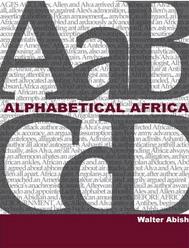
How Alphabetical Is It?

Answer: Very

Walter Abish, author of the critically acclaimed novel How German Is It, had a challenging idea once: to compose an experimental work of fiction that plays with the English alphabet in a constrained manner. And in 1974, he published Alphabetical Africa, a novella that stood as a monument to his idea, built to completion.

It's a one-off work of literature, bold in its ambition, that has never been attempted by anyone else and probably will never be attempted by anyone again. The book consists of 51 chapters of varying lengths. The first chapter is composed entirely and only of words starting with the letter 'a', the second chapter with letters 'a' and 'b', and with each subsequent chapter he adds a letter from the alphabetical series up until, with the 26th, he composes a chapter made of words starting with the entire English alphabet of 26 letters. In the 27th chapter, he subtracts 'z' from the composition and hence it consists of the first 25 letters, and with each subsequent chapter thereafter, one letter is subtracted from the alphabetical series backwards until, at the 51st chapter, he completes the circle and is back to using only 'a'-lettered words.

That idea might intrigue you or it might perhaps even repel you, as some readers distance themselves from disorientating or alienating works of art. But if you belong to the former, rest assured, this is about the most fun literary treats can get. Again, rest assured, all the sentences and sentence structures used in the book conform to the standard English grammar, though they may not as easily be understood as the normal sentences we find in ordinary usage, especially the chapters made of one or a few letters. But that's where the fun lies. An excerpt from first chapter thus goes...

Ages ago, an archeologist, Albert, alias Arthur, ably attended an archaic African armchair affair at Antibes, attracting attention as an archeologist and an atheist. Ahhh, atheism... Anyhow, Albert advocated assisting African ants. Ants? All are astounded. Ants? Absurd.


...and one from the second chapter goes...

Alex and Allen are both bribing a building attendant after building another apartment backstairs, but both also brood after burying a body, brood about Bantu's better beaches and accommodating Alva.


Sentences vary in length, from short and average ones like these to really long ones, and some are quite hard to understand (I've quoted the easy ones above). It's far from being an easy catch in book stores, but thanks to Flipkart, an imported edition is available there for a slightly higher price (considering it is imported and the fact that it is a novella), but then, when the treat is so great, shedding a few extra bucks wouldn't hurt your wallet. A limited sample can be previewed on Google Books if you are curious.

Saturday, October 30, 2010

Who we are

"The surest way to work up a crusade in favor of some good cause is to promise people they will have a chance of maltreating someone. To be able to destroy with good conscience, to be able to behave badly and call your bad behavior 'righteous indignation' – this is the height of psychological luxury, the most delicious of moral treats." – Aldous Huxley

Revenge is sweet. There are several evolutionary advantages that come from this sweet experience of ‘an eye for an eye’ that served our primate and human ancestors well in the ancient world and indeed to an extent today as well: a supposed ‘enemy' or rival is less likely to attack or mess with you knowing that you will seek vengeance in the aftermath of the attack and pursue an equal or worse counterattack. That pre-attack knowledge is a warning in itself that never needs to be uttered. And when an emotion is favorable to a species’ or an individual's existence, evolution makes it feel good, or sweet. The downside of this sweet emotion, however, is that it can dehumanize us to the point of becoming incapable of any sympathy or objective evaluation and blinds us from seeing not only the enemy's condition but also our own.

Because of its feel-good characteristics, revenge is a widely and long used tool in filmmaking. There is at least some element of revenge in almost every Hollywood film released – we not only love the good guys but also love hating the bad guys and wish them dead or worse (and even like to see the reaction on their faces when, to quote Samuel Jackson, they are “struck down upon with great vengeance and furious anger” :) ) Sometimes, gifted directors like Tarantino (who wrote that Jackson dialogue) just push it too far, or too low, and take it down to sly levels of wishful vengeance just to give the audience a treat of maltreating someone (killing, actually) and calling it ‘righteous indignation.’ That is sure to attract more viewers and rake in a lot of bucks and shower more praise on him. No, I’m not talking about Kill Bill, but about Inglourious Basterds, a purported historical fiction.

The world today, and since 1945, hates Nazis. While we all show immense gratitude towards the heroism of the Allies for defeating the Axis powes, especially Nazis, and saving the human civilization from tyranny, we still cannot get ourselves used to the fact that the Nazis did not get what they deserved. They committed the single largest calculated mass murder of an innocent population in human history and conducted unspeakable experiments on them, and all they get for it is a jail term and a fair trial for war crimes? No, that’s not enough. We need more, or wish that they had gotten more. We want revenge. Avenge us, someone!

At least, that’s how the world majority feels today. And feeding on such a strong inner craving, sly and shameless filmmakers like Tarantino create their own personal favorite versions of history and lead events into how they wished it had ended – with Hitler dying of 10,000 rounds of bullets in a movie theater at the hands of our anti-Nazi Jewish hero and him killing the rest of the Nazi leaders in the same enclosure with a machine gun. Never happened, but still. As long as that’s what the audience want to see, who cares what a demoralized filth of a story it is. To make matters worse, our beloved Oscars promoted such irresponsible garbage by nominating it for Best Screenplay, Best Director, AND Best Film categories. To make matters still worse, and as expected, the film was a blockbuster and took home unprecedented accolades.

Historical fiction has been a well-received genre in storytelling for ages; it takes facts that did happen and peppers it with fiction to make a point, to prove a moral, to say something about those events or about the people involved in those events. But Inglourious Basterds, if it does say anything at all, says that we are all brutal savages who seek, as Huxley has rightly put in the quote above, the psychological luxury of destroying and killing with a good conscience. This is evidenced by the undeniable fact that what people loved the most about the film was, despite knowing with absolute certainty that it’s fictional, the merciless killing of the Nazis and their demigod leader, Hitler. They enjoyed it like it was a live News broadcast. A couple of old Jewish women were overheard in a theatre by someone I know saying during the climax, overjoyed as they were, “If only it were true.” The film was even publicized with the tag, “You haven’t seen war until you’ve seen it through the eyes of Tarantino.” Yeah, sure!

Spielberg made a few mistakes like this early on his career with Indiana Jones. He tried to approach the Nazi concept with a certain dose of hatred towards them, him being a Jew and all. But, him being also an intelligent filmmaker, quickly corrected himself and made the gem of modern classics, Schindler’s List, avoiding any and all pitfalls of inducing anti-Nazi hate messages in the minds of the audience and showed with unhindered honesty the presence of compassion amid the cold cruelty of the Third Reich. The moral dimensions of this film are so great that Kubrick, a director who is worshiped by Spielberg himself, abandoned a Nazi Germany film project he was working on at the time because, as his wife later recalled, he felt he couldn’t top Schindler’s List. Spielberg preached humanity with that film, that there is no form of revenge so complete as forgiveness. I just hope Tarantino too wakes up the horror of his own morals before he decides to breed another set of Basterds.

A fairly recent Dutch film called ‘Zwartboek’ (‘Black Book’; director: Paul Verhoeven) deals with the same theme, albeit with a twist. This film, too, has certain elements of revenge in it, but unlike Basterds, it shows us, indeed makes us feel how depraved and base we become while seeking revenge, and also, unlike Basterds, it’s based on real events. A Jewish Resistance girl infiltrates Nazi senior officials’ office disguised as a Nazi supporter and a seductress to help the Resistance fighters with valuable inside information, thus enabling them to launch surprise attacks on the officers. But once the war is over, she is mistaken for a Nazi and imprisoned with the rest of the arrested Nazis in a prison that’s in a condition as deplorable as concentration camps. Now, since it is impossible for any of us to sympathize with a Nazi, and since we know that the innocent girl is a Jew mistaken for a Nazi and is being treated like one with contempt, which in turn earns her our sympathy, it becomes easy for us to see the dissoluteness of our merciless conduct in the name of revenge and how we become what we despise in the process. But Basterds, on the other hand, feeds on such dissoluteness and glorifies it.

No other film, not even the horrendous Indian films (all encompassing: Bollywood, Tollywood, Kollywood, Sandalwood, Wood, etc.), has made me lose faith in humanity so much as Basterds. We may have come a long way since the War, and our morals may have advanced tremendously with acts such as ridding ourselves of capital punishment in a great many nations, but inside, our true primate self still remains the same bloodthirsty animal that were the Nazis. We are all really no different from the Nazis, no matter how much we deny and like to believe otherwise.

As a closing comment, I’ll quote one of my favorite quotations from Stanley Kubrick:

“Man isn't a noble savage, he's an ignoble savage. He is irrational, brutal, weak, silly, unable to be objective about anything where his own interests are involved—that about sums it up.”

Yes, that about sums it up.

Thursday, August 5, 2010

Recently verbified words

A while ago I was wondering what the verb form of nostalgia was, and not unexpectedly thought it to be 'nostalgize'. But I decided to google it anyway and stumbled upon this interesting list of newly verbified words. Has some nice additions to the language:

http://www.ar.cc.mn.us/raygor/rdrverbs.htm

Some words that stand out:

Sunset - To lapse or expire at a preset time. "Don't forget that this commission sunsets at the end of the fiscal year."

Theatricalize
- To make more theatrical or flamboyant. On National Public Radio, Susan Stamberg said of Noel Coward that he had "theatricalized himself."

Yes - To agree to. From the St. Paul Pioneer Press: "Jennifer Aniston, one of TV's 'Friends,' has yessed a marriage proposal by Tate Donovan, late of TB's 'Partners,' according to the Star."

...and many more.

Monday, May 24, 2010

Veblen goods and the psychotic drive for exclusivity

Most things we use – pens, cell phones, cars, bikes, house, and a quadrillion other items that make up our “stuff” (oh, and speaking of stuff, this immortal George Carlin video shouldn’t be ignored, by anyone), follow that seemingly unquestionable law of supply and demand and the price based on it. It’s simple: Supply is high and demand is low, price shoots up; supply is low and demand is high, price crashes down. It’s all high school economics, and if you haven’t been to high school, commonsense would be a good alternative to have thought about it with. A cell phone costs Rs. 10,000 and sells 10,000 pieces a day, and going by the law of supply and demand (LSD – a perfect acronym, hah!), if you cut down the price by Rs. 1000, the sales increase to 11000 pieces a day (only an example, dude). There is sufficient evidence taken directly from the market over the last century and a half in support of LSD to make it a law as commonplace and to-be-taken-on-face-value as the law of gravity in physics or the law of Brownian motion in chemistry. And if something is so consistently evidenced by reality and over such a long time, no one could or should be bold enough to question the law, right?

Wrong. Thorstein Veblen was. An economist – a true economist, i.e., not a wannabe economist like Steven Levitt, author of Freak-on-comics, whose goal is not to explore reality but to overturn conventional wisdom, even if it works – and a sociologist, Veblen was a dispassionate observer of societies and the behavior of people under various economic conditions. Among is immense contributions to the field of economics is an observation that is as important to understanding market economics as the LSD, and, as I might have hinted till now, it runs counter to the LSD. Veblen proposed the idea that certain goods will disobey the LSD and yield ironic results if you do what is generally acceptable for goods that do obey the LSD: if you cut down the price, then contrary to the expectations of demand rising up and hence the product selling more, it starts to sell less and becomes less preferred in the market. The very reason they sell more is because of, not in spite of, their high price. Sounds weird? Even if it doesn’t sound weird, it is weird. Here’s how it works, sort of.

Humans have a very strong desire for exclusivity. We want to own things that few other people do, or better yet, only we do. We sometimes go to great lengths to possess it; the desire for the first place in a race, even if the race itself carries no meaning or purpose, the desire to own luxury cars, unmatched racer bikes, diamonds, designer edition clothes and shoes, watches made of 24 carat gold, spoons and forks made of gold… Owning any of these changes our image in the society or at least amongst acquaintances, and with the exclusivity their possession brings to us, we set ourselves, if only virtually, above all those who lack them. Despite the fact that there is nothing inherent to the quality of the product or the product itself that would justify its price, its very exclusivity sets a high price. In other words, the product becomes a status symbol. In some more words, the high price it is tagged is not for its quality but for its exclusivity.

Price drives exclusivity, and exclusivity drives (pseudo)status. Then status drives exclusivity back again, and it enters a self-feeding spiral.

Cutting down the price makes it more affordable to a section of the market that is larger than the pre-price-cut section. And with that, exclusivity of the product is also cut down to a certain degree. You might think how would making something more affordable to a larger group of people result in its selling less, but as pointed out, because of the drop in its exclusivity, there follows a drop in the market preference for the product, and since there is nothing inherent about the quality of the product that would justify the freakishly high price, the demand doesn’t go up to counterbalance the drop in preference that ensues the price cut. As a result, the demand curve has nowhere else to go but down.

Rolls Royce recently released its latest engineering marvel called Ghost. Its price was set at Rs. 2.3 crores. There were 25 bookings for the car in Delhi. Technically speaking, there is nothing about Ghost that is not already present in Mercedes Benz. They are both equally advanced, and advanced they both are enough to justify a price that is around what Benz has to offer. But Rolls Royce set its price more than five times what the same technology is on offer with Benz, making it a lot more expensive and hence much more exclusive than any Benz model to date. And the 25 status-conscious pricks needed just that!

Here are some more Veblen goods with which a high superficial social status is attached, mostly because of the high price and partly because of the good quality. All these products were featured in the Forbes annual special edition called “Luxury Must-Haves for Every CEO”. The title itself suggests an irrational desire to separate the CEO from the rest of the working class.

Vertu Signature. A cell phone. Cost: Rs. 6.46 lakh
Amosu Blackberry Curva. A cell phone. Cost: Rs. 95 lakh
Piaget Polo FortyFive. A watch. Cost: Rs. 9.0 lakh
Audemars Piguest Royal Oak Offshore Chronograph. A watch. Cost: 14 lakh
Panerai Radiomir Tourbilln. A watch. Cost: 61.87 lakh
Mont Blanc Mahatma Gandhi 241. A pen. Cost: Rs. 11.39 lakh
Luciano Barbera. Men’s suit. Cost: Starting at Rs. 2 lakh
Ermenegildo Zegna 14 Micron Couture Suit. Men’s suit. Cost: Rs. 2.48 lakh
Brioni MTM suits. Men’s suit. Starting at Rs. 3 lakh, up to Rs. 35 lakh

There are many more. Google them for pictures/info. There is a sentence in the description of Luciano Barbera, and I quote without paraphrasing: “This is as exclusive as it gets.”


Rolls Royce Ghost

Sunday, May 16, 2010

Four secrets of English writing


Usage affects the evolution of language. The way we are using English on the Internet will forever earn us the scorn of future generations of English speakers/writers, which is why it is imperative that someone makes clear these four most basic rules of sentence construction, since, apparently, most of us either never learnt it or haven't paid enough attention to it to. There are, of course, many more rules pertaining to sentence construction and punctuation, but following the following four would make reading a great pleasure for the readers. So, here goes:

1. Every sentence begins with a capital letter. Always.
2. Choose only one of the following to terminate a sentence: . ! ? Do not use an exclamation mark and a question mark in combination to express/ask a surprised question.
3. After you've made your choice in Rule 2, use it ONLY ONCE. Using 27 exclamation marks at the end of a sentence doesn't mean you have a point. If you really do have a point, just one exclamation mark, if deemed necessary and appropriate, would suffice. And by extension of Rule 1, every sentence is terminated by only one period (or full stop). Always. Furthermore, it's easier to use one than seven or eight.
4. There exists a space after a period (or full stop) and a comma. Be wise in using or not using commas. "Let's eat, grandma" is not the same as "let's eat grandma."

While occasional typos and punctuation or capitalization errors can be forgiven, celebrating our ignorance of it cannot be. It's not enough to get the point across. That's like saying as long as there is a ground to sleep on and a roof to protect us from the sun and rain, it's enough. No, its not.

Thursday, May 13, 2010

Bertrand Russell: Three


An autobiographical piece of Bertrand Russell I find interesting. The third one is spot-on.

Three passions, simple but overwhelmingly strong, have governed my life: the longing for love, the search for knowledge, and unbearable pity for the suffering of mankind. These passions, like great winds, have blown me hither and thither, in a wayward course, over a deep ocean of anguish, reaching to the very verge of despair.

I have sought love, first, because it brings ecstasy—ecstasy so great that I would often have sacrificed all the rest of life for a few hours of this joy. I have sought it, next, because it relieves loneliness—that terrible loneliness in which one shivering consciousness looks over the rim of the world into the cold unfathomable lifeless abyss. I have sought it, finally, because in the union of love I have seen, in a mystic miniature, the prefiguring vision of the heaven that saints and poets have imagined. This is what I sought, and though it might seem too good for human life, this is what—at last—I have found.

With equal passion I have sought knowledge. I have wished to understand the hearts of men. I have wished to know why the stars shine. And I have tried to apprehend the Pythagorean power by which number holds sway above the flux. A little of this, but not much, I have achieved.

Love and knowledge, so far as they were possible, led upward toward the heavens. But always pity brought me back to earth. Echoes of cries of pain reverberate in my heart. Children in famine, victims tortured by oppressors, helpless old people a hated burden to their sons, and the whole world of loneliness, poverty, and pain make a mockery of what human life should be. I long to alleviate the evil, but I cannot, and I too suffer.

This has been my life. I have found it worth living, and would gladly live it again if the chance were offered me.

Saturday, April 24, 2010

When Clevinger became their scapegoat


Catch-22 is perhaps one of the most original novels of the 20th century, that, while being outrageously hilarious, mirrors human nature with a kind of accuracy not often seen in fictional novels. It mocks and satirizes the evil in people, especially when they are subject to conditions where their raw nature can come out unhindered, not bounded by any limitations. Such as in World War II, the background of this story.

The entire novel is as funny as funny can get, but towards the end of the eighth chapter it takes a serious tone for the first time. And the seriousness of it is so powerfully presented, it gave me an episode of depression after reading it. Depression not just regarding the character in action, but over the harsh truth about humans that is so starkly depicted in those few words. I'll quote them for you.

But before I do that, here's a brief summary of the scene that's happened till the quote: Clevinger, a cadet for the US Army, is brought on trial in front of the US military Action Board in his camp - consisting of three men: "a bloated colonel with big fat mustache", Major Metcalf, and Lieutenant Scheisskopf - for conspiring to overthrow the cadet officers appointed by a paranoid Lieutenant Scheisskopf, who is frantic that if nothing is done about it, Clevinger will one day overthrow the world. After a long and very hilarious trial, Clevinger is found guilty, without any evidence or relevant claims, and is sentenced to walk fifty-seven punishment tours. A punishment tour for Clevinger was fifty minutes of a weekend hour spent pacing back and forth before the provost marshal's building with a ton of an unloaded rifle on his shoulder. (And just for reference, Yossarian, whose name is mentioned below, is the unbelievably stupid and funny protagonist of the novel.)

These two paragraphs follow and conclude the chapter:

It was all very confusing to Clevinger. There were many strange things taking place, but the strangest of all, to Clevinger, was the hatred, the brutal, uncloaked, inexorable hatred of the members of the Action Board, glazing their unforgiving expressions with a hard, vindictive surface, glowing in their narrowed eyes malignantly like inextinguishable coals. Clevinger was stunned to discover it. They would have lynched him if they could. They were three grown men and he was a boy, and they hated him and wished him dead. They had hated him before he came, hated him while he was there, hated him after he left, carried their hatred for him away malignantly like some pampered treasure after they separated from each other and went to their solitude.

Yossarian had done his best to warn him the night before.

"You haven't got a chance, kid," he told him glumly. "They hate Jews."
"But I'm not Jewish," answered Clevinger.
"It will make no difference," Yossarian promised, and Yossarian was right. "They're after everybody."

Clevinger recoiled from their hatred as though from a blinding light. These three men who hated him spoke his language and wore his uniform, but he saw their loveless faces set immutably into cramped, mean lines of hostility and understood instantly that nowhere in the world, not in all the fascist tanks or planes or submarines, not in the bunkers behind the machine guns or mortars or behind the blowing flame throwers, not even among all the expert gunners of the crack Hermann Goering Antiaircraft Division or among the grisly connivers in all the beer halls in Munich and everywhere else, were there men who hated him more.


That quote, right there, SPEAKS to me!

Thursday, April 15, 2010

Roots of inequality? Maybe


I might be a little late to this, but I couldn't let it be just a passing thought. Being exposed to Jared Diamond's work lately, I had the luck of acquiring a copy of his 1987 five-page essay titled The Worst Mistake In The History Of The Human Race (pdf accessible here). This was published almost a decade prior to his much-acclaimed, Pulitzer-winning non-fiction book Guns, Germs, and Steel (here onwards referred to as GGS), and was written during the course of his 30-year research into the question that both the book and this essay deal with - namely, the influence of weapons, environment, diseases, geographical luck, and most importantly, agriculture & domestication on the development of human race and evolution of world civilizations and societies (the question being: "Why are some parts of the world, and the people living in them, more advanced than others?"). But before I proceed with my criticism and comments, I need to state clearly that Jared's approach to explaining the development of human societies across the globe is strictly and firmly non-racial; he downright discards all notions that genetic factors, notwithstanding rare and minor implications, were in any way responsible for the advancement of some civilizations and the stagnation of others. This view is shared by modern science as well, with the 2000 Human Genome Project discovering that 99.98% of all human genes of all races are identical.

Judging by such a bold title, I was initially skeptical of what he had to say, but as I went through the essay page by page, I was to some extent convinced by the argument, but (but again!) soon, much to my disappointment, I uncovered certain holes or "skipping" of logical next-steps in a couple of places. Over the evening I was preoccupied with the argument in an attempt to find more holes and thus feel proud of my critical reasoning skills, but to the contrary, I could fill in the already-found holes by myself and felt the argument to be at least partly convincing once again. (I was like, "Well yeah, it is plausible.") I'll address them in a while.

Jared's theory in this essay is focused mainly on the changes taking place in any one arbitrary hunter-gatherer society with the advent of agriculture, as opposed to his theory in GGS which focuses on the changes taking place in the human race as a whole with the advent of various factors. In a nutshell, he submits that agriculture, with all its advantages and benefits, brought upon us an unanticipated evil so great that it plagues the world to this day and has had dire consequences on civilizations throughout human history. And that evil is inequality - inequality in all its forms, ranging from class to gender to skin tone to you name it! It was only after we invented agriculture, says Jared, that the first signs of inequality began to show up. Hunter-gatherer societies, that is the pre-agriculture groups, had little to no reason to divide themselves into classes; everyone had such a crucial role to play in the food accumulation process alone that any division of a society on any basis would only threaten the very survival of the entire group. But with agriculture, all that changed.

The emergence of agriculture was a turning point in history, as the cliché goes. It provided, in relatively abundant quantities, the one indispensable source of survival: food. Farming cut down the time and labor expense needed to find scant and scattered sources of food in the forests through hunting by many fold, effectively reducing the burden on much of the population and hence freeing them of, or at least stripping some of the work load previously borne by them in hunting and gathering. This is a well-established fact in archeology, one that is supported by evidence. As the burden came down, they were able to devote time to other activities (not necessarily leisure), and women, especially, were able to either better care for their children or, because of the dwelling at one place - a new lifestyle - brought about by agriculture, were able to carry more children and hence grow their population faster and provide sufficient food for the extra population through the harvests. (Read the essay for a more in-depth explanation of this section).

Agriculture almost seemed at the time to be a godsend, all-encompassing boon, giving them not only a year-round supply/storage of food they used to so desperately search for but also ample time to expend on developing other survival skills. But amid all this progress and without their knowledge was also taking birth the seeds of inequality which would later determine who amongst them gets to eat, who doesn't, and who does how much. This is where I tumbled upon a missing logical next-step in Jared's argument.

To quote from the essay: "Hunter-gatherers have little or no stored food, and no concentrated food sources, like an orchard or a herd of cows: they live off the wild plants and animals they obtain each day. Therefore, there can be no kings, no class of social parasites who grow fat on food seized from others. Only in a farming population could a healthy, nonproducing elite set itself above the disease-ridden masses."

The part about hunter-gatherers not having classes is obvious; as I mentioned earlier, everyone played an equally important role in food production process that division would preclude survival. But the last sentence in that quote - about a healthy, nonproducing elite setting itself above the disease-ridden masses - is the part that is elusive, as Jared fails to explain exactly how that is possible. Why, you might ask, would a producing "lower" class feed a nonproducing "higher" class and let them live healthily at the expense of their own health. If you were a farmer when farming was invented, would you grow crops and domesticate animals only to feed an elite class that doesn't? You might as well ask them to sod off and eat all your crops yourself rather than just giving it away to some other higher class that neither produces nor shares your ill-health. And even if you are crazy enough to do that, why on earth would you be tagged "lower class" while those who don't produce and feed on your food be tagged "higher class"? Why can't it be the other way round? For, you are the power house of the community, and if anything, it is you who should be placed and revered above everyone else in the community because it you who has saved them all the labor of hunting and provided them with the time to fuck about. Why, then?

Jared conveniently skips answering all those questions and hops from "man invented agriculture" to "man succumbed to deep-class division". He partly draws his conclusion from the way it is today: look at the state of farmers, regardless of the country, and compare them with the nonproducing class of the same country that depends on the farmer for food demands. Or, on a larger scale, an example which Jared himself cites, look at America depending for oil on oil-producing nations of the Middle East and still being better off economically and socially than those nations. The conclusion is clear: producing class is often given a lower social status than non-producing class. But how and why did it happen are the questions that have been denied an answer here. (Additionally, while comparing the farmers of today with the farmers of those day, one needs resist the temptation to ignore the pivotal role money plays. Farmers today produce for money, and farmers of those days had no concept of money.)

The answer lies partly in human nature and partly in the characteristic of agriculture. As noted, farming is an immobile form of food production. Populations harvesting a crop need to dwell at a single place - close to or next to a farm, for example - over long periods of time. In the fullness of time, the population grows, communities become villages, villages grow in size. While this dwelling does provide several advantages over hunting, it also poses a serious threat: the threat of invasion by a foreign group. This behavior has been confirmed by evolutionary biologists for apes, and anthropologists, historians and evolutionary biologists for human beings as well. When food sources run low (either because of the food reserves running out or because of the population exceeding the sustainability of those reserves), we, the modern apes, go in search of other sources elsewhere. During the search, if encountered by other groups (which are by now rivals) who have already taken control of the much-needed food, a conflict occurs and heads roll. The winner stands alone, the winner takes it all. All this is true even today, although with humans today greed plays a role as important as the survival instincts. But with the hunter-gatherer communities, this didn't pose a major problem because they were always on the move and never had the worry of an invader invading 'their' land. They had no land of theirs. Even with them conflicts of this nature occurred, but they were insignificant enough to not make a difference to the social structure of their communities. Farming, however, needed protection from invaders, and that is where the security-providing soldiers enter into the equation.

An average American farmer today feeds the stomachs of 165 people worldwide, i.e., a producer-to-consumer ratio of 1:165. (I wish I had the numbers for Indian farmers). 40 years ago, that American farmer fed 28.5 stomachs (source). This drastic change can be attributed to the research and development in agricultural practices of yesteryears. So the farmers of nascent agricultural era can be expected to have produced a much lower yield for their crops, as their practices of farming were much more primitive and undeveloped than today's. Even if we assume a producer-to-consumer ratio of 1:1.25 for them (note that it has to be greater than 1:1, else it wouldn't have made much sense to migrate from hunting-gathering to farming), that is, one farmer feeding 1.25 stomachs, it would have still freed up about 12.5% of the population from the duties of food production. This 12.5%, being skilled as they were at hunting and handling weapons, could now put their skills to use in developing a defense system for the farming community. And the deal? Since money didn't exist, the farmers would pay them in the form of food in exchange for protection, as they are already producing an extra 12.5%. This has effectively formed the first societal division: the division between the farming class and the defense class. The defense class now needs to be organized, as an unorganized army is as easy to defeat as a community without an army. This therefore calls for leadership, resulting in the subdivision of army into various levels of hierarchy, at the top being the leader or commander-in-chief who has control of the army and over how the army advances and occupies surrounding land area for the needs of growing community size, thereby establishing himself as the King, the royal family, or the supreme owner of the land. He now begins to collect taxes in the form of food from farmers - not just for the land they are being allowed to farm in but also for the protection and other facilities such as road, housing et cetera he is providing them (not very different from the tax system we have today in our government, except that in our system much of the tax money comes back to the public in the form of services). Wealth (food) now begins to accumulate more than the needs of the royal family and at the expense of the needs of the producing class.

Despite being responsible for production, farmers would end up paying their share of food in the form of taxes to the royal family and through them a share of it to the army. Even if their production ratio continues at 1:1.25 or higher, because of the taxes and the growing army size, they might have to cut down their own share of the '1' and add it to the '1.25'. This apparently leads to poor nutrition and ill health of farmers and the good health of royals. Since protection is obviously more necessary and important than just good health, farmers are left with no choice but to yield to the demands of the King and his soldiers. The King being the commander and the farmer being the obeyer, and the King being 'richer' than the farmer, the former gets a "higher" social status while the latter gets a "lower". And with that, a new master-obeyer relationship was born.

Meanwhile, during the formation of this defense system, because of increased food production-to-consumption ratio over time, several sub-classes are formed which aren't directly part of the army but without which the army would be worthless. Blacksmiths, an example, are essential to armory (the fact that farming allows a part of the community to devote entirely to the development of arms cannot be ignored). Cooks, another example, are essential to providing cooked food to the soldiers and the King. And since these blacksmiths and cooks themselves need protection from foreign invasion, they are as obliged in their duty to the King and his men as the farmers, but are not farmers in themselves, leading to the inception of two more social classes. Likewise, many other classes could have formed feeding almost entirely on the food produced by the farmer and at the same time leading to a division of society into various classes of various ranks, the farmer being at the bottom of the pyramid.

A mere 1:1.25 producer-to-consumer ratio could produce that much inequality within a community, and with every incremental rise on the right hand side of the ratio, a higher percentage of the population was freed of its food-producing duties which could then be handed over to other self-preservation activities. In fact, it is very tempting to conclude that the more food a farmer produced (i.e., the higher the producer-to-consumer ratio), the more the social classes that took birth and the more the ensuing inequality that propagated in the community. Look at the modern world today. If you strike off the 1:165 producer-to-consumer ratio and if one individual was solely responsible for producing food for oneself, directly or indirectly (i.e., if the producer-to-consumer ratio came down to 1:1), then not only would the world population drop drastically, but almost all societal divisions would vanish altogether. Development, in all its form, would come to a grinding halt, since if every person is expected to produce and consume his/her own food, there wouldn’t be much time or energy left for any other activities that propel the modern world towards progress. The only activity then would be to grow/hunt food, cook, eat, and regurgitate. And perhaps some spare time for recreation.

That finally brings me to the end of this criticism, which oddly is almost as long as the essay itself. Jared asserts that the shift from hunting to agriculture was the biggest mistake in human history, that hunting, despite feeding very few stomachs and therefore limiting human reproduction, was better than farming in that it precluded inequality amongst the people who practiced it. I beg to differ. While it may be true (I said in the second paragraph that I'm only partially convinced by this theory, given that there isn't sufficient evidence to definitively and conclusively make any claims) that farming brought about certain additional inequalities in human society (keyword: additional; I'm not convinced that agriculture is the root of all inequalities, and certain inequalities such as gender and age and appearances could already have been present in hunter-gatherer societies), it also cleared the way for exponential human progress on unprecedented levels, the likes of which the human mind had never before imagined. Farming made the modern world possible, farming gave birth to innovation on mind-boggling scales, and, most importantly, farming provided the very sustenance for our species to survive on and grow. Farming, in other words, regardless of all the evil it imposed upon us, is the biggest best-thing to have happened to us in all human history. Every coin has two faces. Deal with it!

Footnotes:
1. Read the essay.
2. Watch a 3-hour PBS documentary based on Jared Diamond’s Pulitzer Prize-winning book, Guns, Germs, and Steel, which also deals with the same subject albeit with a different focus, here: http://www.youtube.com/watch?v=bgnmT-Y_rGQ. And if you are lucky enough to be in my small circle of friends*, ask me for the documentary and I’ll give you a copy myself.

*Just kidding